Support Chat
Problem
In this day and age, users expect to be able to get help instantly. At Tripadvisor, we had received feedback that restaurant owners found it difficult to get in touch with us to resolve issues about their listing or paid products.
User stories
As a restaurant owner, I want to quickly get answers to my questions regarding Tripadvisor’s products, so that I can go back to managing my business.
Business case
Of course, before building a feature like this, we needed to make sure that:
-Our support team would have the capacity to handle the additional volume of tickets that chat would create, while maintaining their high standard of customer care.
-That this feature would improve key metrics such as Customer Satisfaction, Net Promoter Score, and help indirectly increase sales and reduce churn.
Oftentimes, support is (understandably) seen as a cost rather than an investment and so part of this project involved data analysis and influencing key stakeholders to allow a pilot to take place.
Solution
Our agents were already on Salesforce so we decided to use Salesforce’s out-of-the-box chat in order to benefit from all the existing backend workflows.
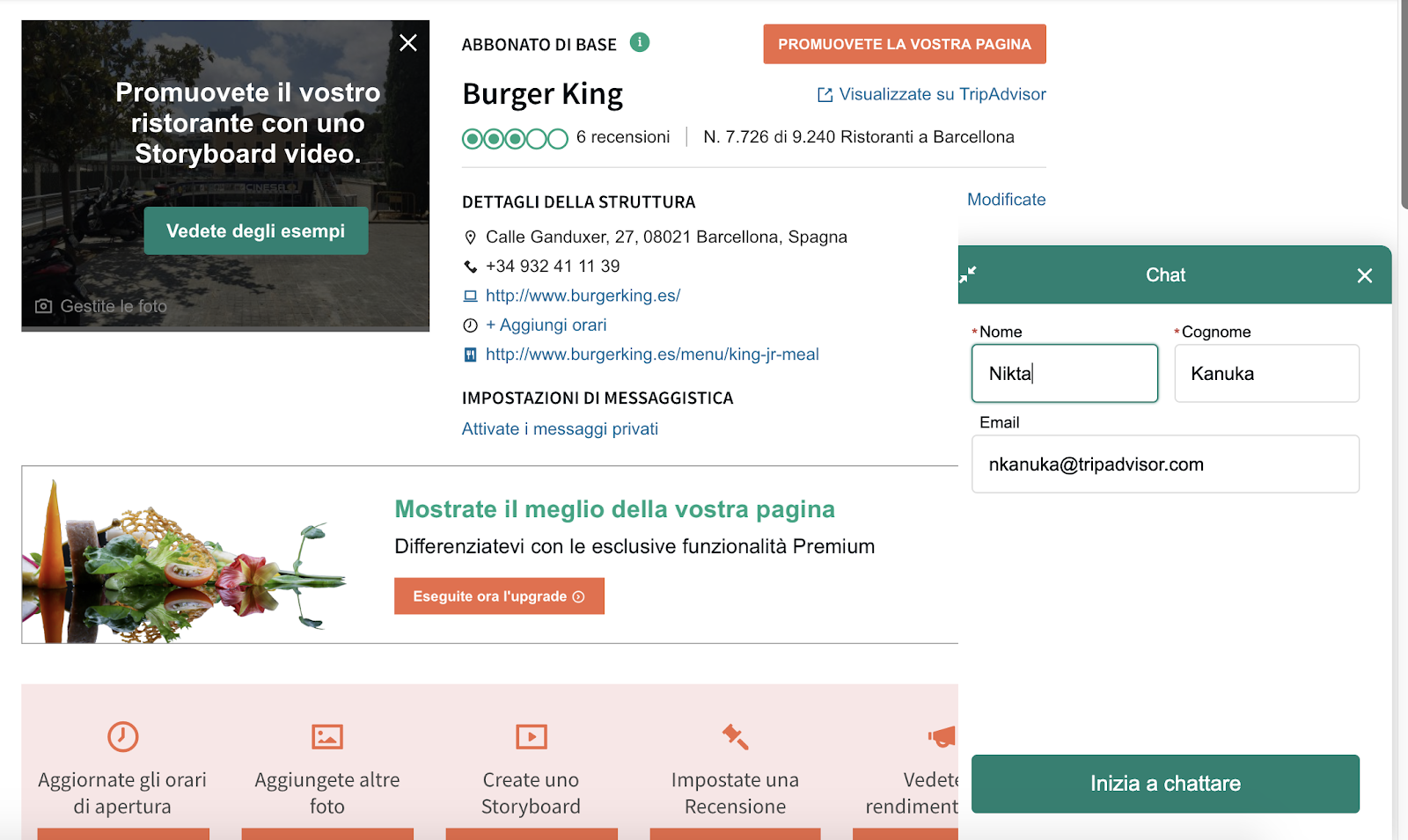
Pilot
In order to mitigate the business risks outlined below, we decided to roll chat out to a limited market to get a sense for the volume we can expect. We chose to roll chat out in the three countries where we had relatively weak NPS scores, because we figured the additional attention to restaurant owners in these markets could help life NPS.
The data from the pilot was very encouraging: CSAT scores were significantly higher than email—in line with the CSAT from phone calls. Of course, one agent can be on 3+ chats at the same time, but you can only ever be on one phone call.
At the same time, the data showed that chat allowed our team to speak with owners that they would never have spoken to before (meaning, chat didn’t cannibalize from email or phone). This suggests that more users will find it easy to get in touch with Tripadvisor from now on, since they clearly hadn’t been able to get a hold of us through the more traditional ways.
Finally, we ran some complex analytics on the data to see if users who were not subscribed to any paid products are more likely to purchase them after a chat interaction. It turned out that they were! These results sparked some thought-provoking conversations around correlation vs causation.